
What Is AI and How Can It Help My Business?
A plain guide to AI for business owners: what AI is, the real use cases, the honest costs, and how to find where it fits with a free readiness check.
 Ibrahim Mizi
· 9 min read
Updated
Ibrahim Mizi
· 9 min read
Updated 
AI is computer systems that do tasks which normally need human intelligence, and for a business it usually means one of four things: drafting content, automating routine work, finding patterns in data, or handling customer queries. OpenKit helps UK businesses work out which of those actually fit, and where AI is the wrong tool. This guide is the plain version: what AI is, what it is genuinely good at, what it costs, and how to find your starting point without a big bet.
Last updated 8 July 2026.
Why AI is worth your attention now
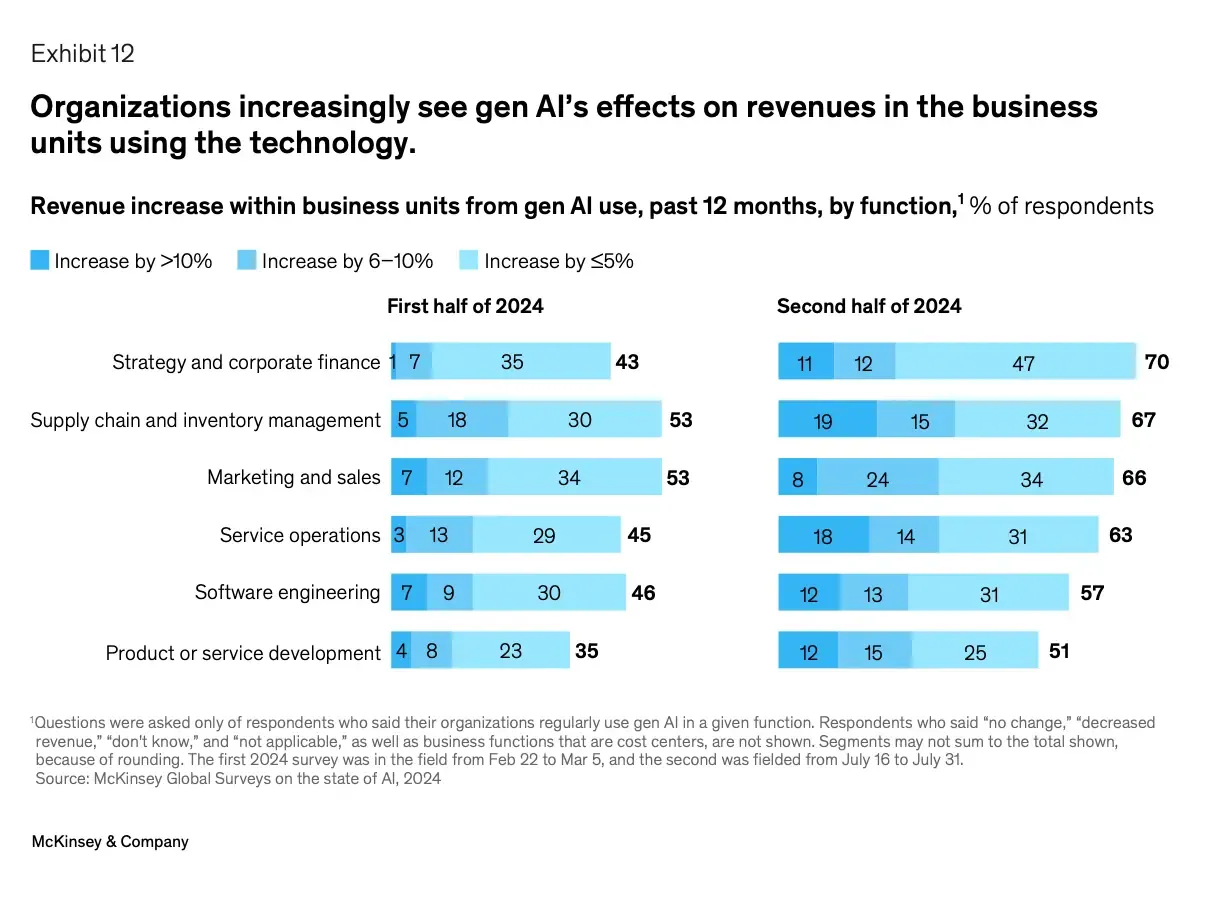
AI has moved from a buzzword to something most businesses are quietly testing. McKinsey’s 2025 State of AI report found that organisations using AI in a business unit are increasingly reporting revenue and efficiency gains there, and adoption is now mainstream rather than experimental.[1]
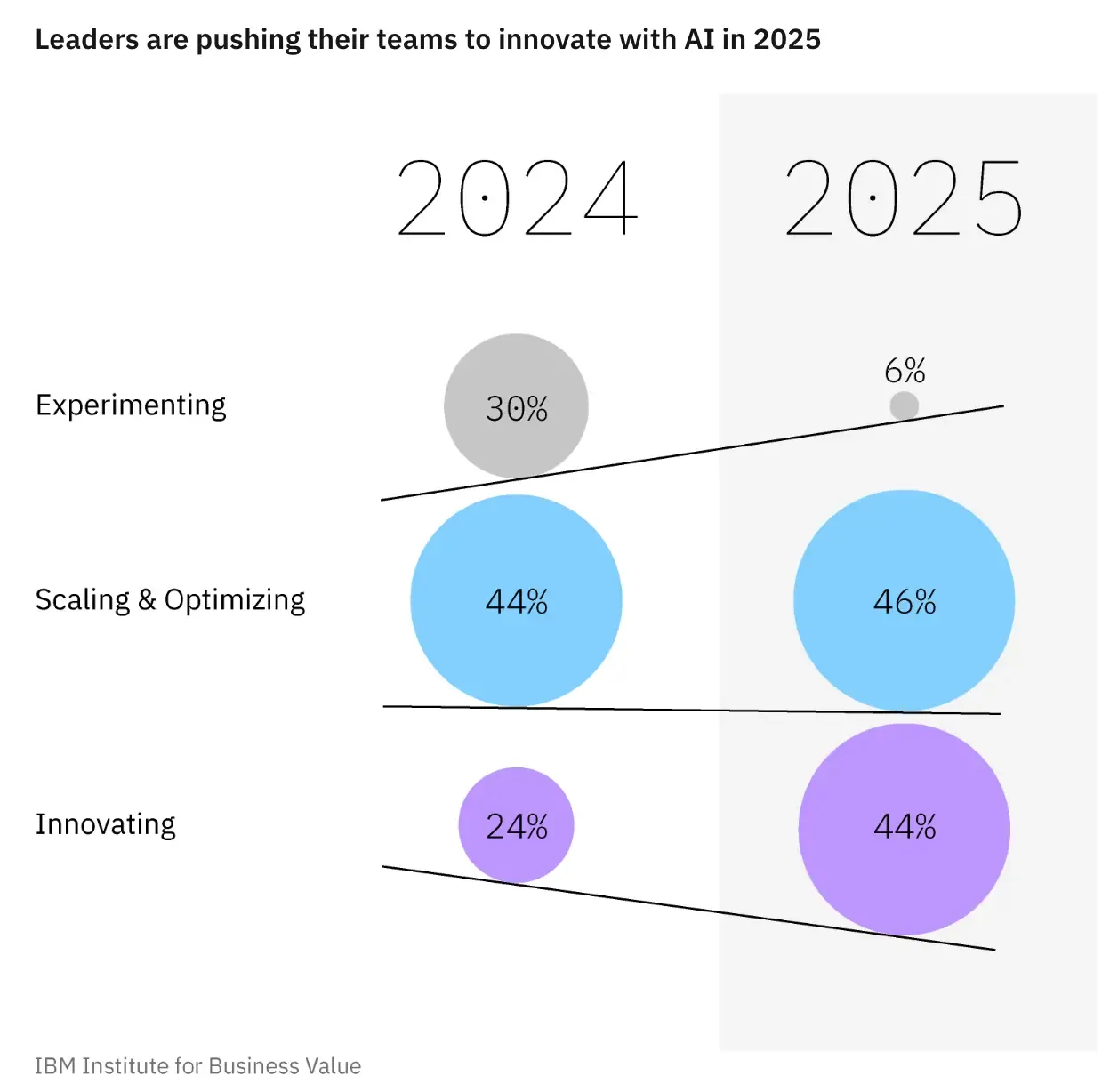
The direction of travel is clear on the buyer side too. IBM’s business trends research found that around 46% of executives planned to roll AI out at scale to streamline operations and 44% to drive new innovation, with only a small minority intending to stay in pilots.[2] The point is not that you must adopt AI to survive; it is that the tools are now cheap and capable enough that not knowing where they fit is a real gap.
What AI actually is, in four categories
In a business setting, AI falls into four practical buckets.
- Generative AI. Tools that write text, code, or images, such as ChatGPT or Claude. Good for drafts, not final answers.
- Automation AI. Systems that clear routine workflows like invoicing, scheduling, and data entry.
- Analytical AI. Systems that read data, find patterns, and support decisions.
- Customer-facing AI. Chatbots and assistants that handle support and simple transactions.
Most useful projects combine a couple of these rather than fitting neatly into one. The label matters less than the job you need done.
Why this now reaches small and medium businesses
AI used to need an in-house data team. It doesn’t anymore. Cloud services and open-weight models have brought capable tools down to affordable monthly subscriptions, with entry-level products starting around £20 to £50 a month, so an SME can access the kind of analysis that was once enterprise-only.
The benefits are real when the use case is chosen well. AI can take a meaningful share out of customer-service cost, lift conversion through better personalisation, and shorten slow internal processes. The honest caveat is that these gains come from targeting a specific task, not from adopting AI in the abstract, and the businesses that get burned are usually the ones that bought a tool before they had a problem for it to solve.
What AI looks like in practice
Automating repetitive work is the most common starting point. AI-assisted invoice processing turns hours of data entry into quick validation, and the same pattern covers scheduling, summarising, drafting replies, and classifying documents.
For document-heavy work, the gains can be large. OpenKit’s BAiSICS platform applies AI to legal document review, taking a review that took around two hours down to roughly ten minutes, at 92% faster processing and 96% extraction accuracy, and saving the firm over £200,000 a year. The people stay in charge of the judgement; the machine takes the volume.
Customer service is another proven area: AI assistants handle common questions around the clock and hand the hard ones to a person, which raises capacity without raising headcount. And voice AI now handles natural phone conversations for booking and first-line support. Across all of these, the winning pattern is the same, AI does the repeatable volume and a human owns anything that carries risk.
The concerns worth taking seriously
The hesitations most UK businesses raise are reasonable, and worth answering honestly rather than waving away.
Cost and complexity are usually overestimated. Entry-level tools are cheap and many need no developer to set up. A simple sum makes the point: a £50-a-month tool that saves fifteen hours of work priced at £50 an hour returns far more than it costs. The trap is not the subscription; it is buying several and using none.
Data privacy is the concern that deserves the most care. UK adults report real anxiety about how their data is used, and the EY AI Sentiment Index 2025 found that 71% of UK respondents worried about security breaches, 65% about privacy, and 67% about whether AI outputs can be trusted.[3] That maps onto a genuine obligation: sending personal data to an AI tool without the right controls can breach the UK GDPR and the Data Protection Act 2018. The EU AI Act adds further duties around risk and transparency for in-scope systems, and it catches UK companies by the role they play rather than by where they are registered. The free EU AI Act applicability check at AI Governance Check tests your own position against those roles. This is exactly where AI governance and compliance earns its place, and where OpenKit’s ISO 27001 and ISO 9001 certifications and Cyber Essentials accreditation give a firm footing.
Trust and ethics follow the same logic. The way to build confidence is not a policy nobody reads but a clear position on what AI is allowed to touch, human review where decisions matter, and a record you can show later.
How to get started without a big bet
You do not need a strategy deck to begin. You need to know where time is being lost and whether you are ready to fix it with AI.
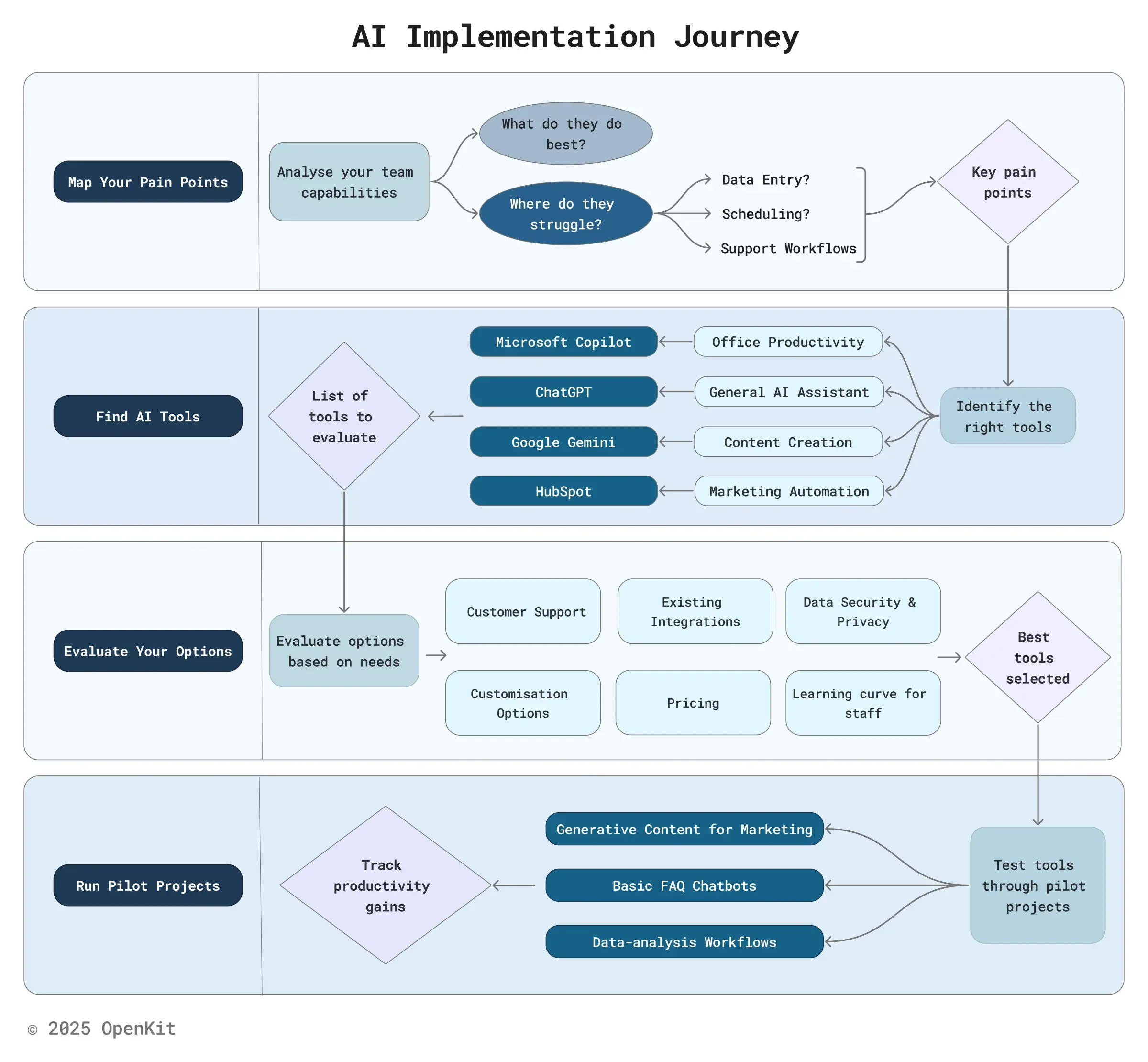
- Map the pain. List the tasks that are slow, error-prone, or tedious, and be honest about which ones a person should keep. Our free AI readiness check gives you a baseline across data, skills, and governance in a few minutes.
- Rank the options. Not every pain point is worth an AI build, and the fastest way to waste money is to build the wrong one. An AI audit ranks your candidate use cases so the spend follows the evidence.
- Try before you commit. Prove the idea on one workflow with an off-the-shelf tool, a small automation, or a simple chatbot, and measure the result.
- Scale what works. Once one use case has earned its keep, widen it, and only then consider a bespoke build where nothing off the shelf fits.
When you are comparing tools, a short checklist keeps you honest.
| What to check | What good looks like |
|---|---|
| Data security and privacy | Handles data in line with UK GDPR and the Data Protection Act 2018; clear on where data goes |
| Staff usability | No-code interface, tutorials, minimal training |
| Integration | APIs or connectors for the systems you already run |
| Pricing at scale | Predictable, with free tiers or trials to test first |
| Support and control | Responsive support and the ability to adjust workflows |
The takeaway for SMEs
AI is now accessible to small and medium businesses, not just large enterprises, and starting small delivers the fastest measurable wins. Pick one or two high-impact tasks, keep a person in charge of anything that carries risk, and treat AI as a way to augment your team rather than replace it. The businesses that do well are not the ones that adopt the most AI; they are the ones that adopt it where it actually pays.
If you want to know where that is for your business, the honest first step is the free AI readiness check, and we are glad to talk it through from there.
References
- McKinsey & Company. (2025). The State of AI: how organizations are rewiring to capture value, accessed on 8 July 2026, https://www.mckinsey.com/capabilities/quantumblack/our-insights/the-state-of-ai
- IBM Institute for Business Value. (2025). 5 Trends for 2025, accessed on 8 July 2026, https://www.ibm.com/thought-leadership/institute-business-value/en-us/report/business-trends-2025
- EY. (2025). EY AI Sentiment Index 2025, accessed on 8 July 2026, https://www.ey.com/en_uk/newsroom/2025/04/ey-ai-sentiment-index-2025

What is AI, in business terms?
AI is computer systems that do tasks which normally need human intelligence, like understanding language, spotting patterns in data, and making or supporting decisions. For a business it usually shows up as four things: generative AI that drafts content, automation that clears routine work, analytical AI that finds patterns in your data, and customer-facing assistants.
How can AI actually help a small or medium business?
By taking the volume off work people don't enjoy and shouldn't be doing by hand: invoice processing, document review, first-line support, reporting. Off-the-shelf tools start at roughly £20 to £50 a month, so the entry cost is low. The value comes from picking one or two high-impact tasks rather than trying to 'do AI' everywhere at once.
What should I check before adopting an AI tool in the UK?
Whether it handles data in line with the UK GDPR and the Data Protection Act 2018, whether your staff can use it without a developer, whether it integrates with the systems you already run, and how its pricing behaves at scale. If it touches personal or regulated data, treat data governance as a design question, not a box to tick at the end.
Where should I start with AI?
Start by mapping where time is lost, then check your readiness honestly across data, skills, and governance. A free AI readiness check gives you a baseline in minutes, and an AI audit ranks which use cases are worth building before you spend on any of them. Prove value on one workflow, then scale what works.
See where you stand first.
Not ready to talk yet? Start with the readiness check: ten questions, a score out of 100 and the next steps we would suggest, in about five minutes.
Keep reading
The closest pieces to this one, by shared ground.